

A graphic design subscription is a flat monthly fee for ongoing access to a design team. Instead of scoping, quoting, and approving each project separately, you add requests to a queue, set their priority, and the team works through them at an agreed pace with a defined number of projects in progress at once.
For a technology, data center, or IT hardware marketing team, the model matters because design demand rarely arrives as one tidy project. It arrives as a launch deck, a data sheet update, a set of paid social variants, a partner banner, a trade show screen, and a landing page, often in the same fortnight. A subscription is built for that kind of continuous, mixed workload.
Every graphic design subscription rests on five mechanics:
- A fixed monthly price instead of per-project quotes.
- An unlimited request queue that you prioritize.
- A limit on how many projects are actively in progress.
- An average turnaround for typical requests.
- One team that keeps your brand, templates, and product context from request to request.
This guide explains how those mechanics work, the 10 benefits they create, what the model costs compared with hiring and other outsourcing options, where it does not fit, and how to evaluate a provider.
How a Graphic Design Subscription Works
The most important idea to understand is that you are buying capacity, not a list of deliverables. The subscription gives you a team's continuous attention. What you get out of it depends on how you brief, prioritize, and review work.
"Unlimited requests" means the queue has no cap. It does not mean unlimited work happens at the same time. Each plan allows a set number of active projects. When one is approved, the next request in your queue moves into production.
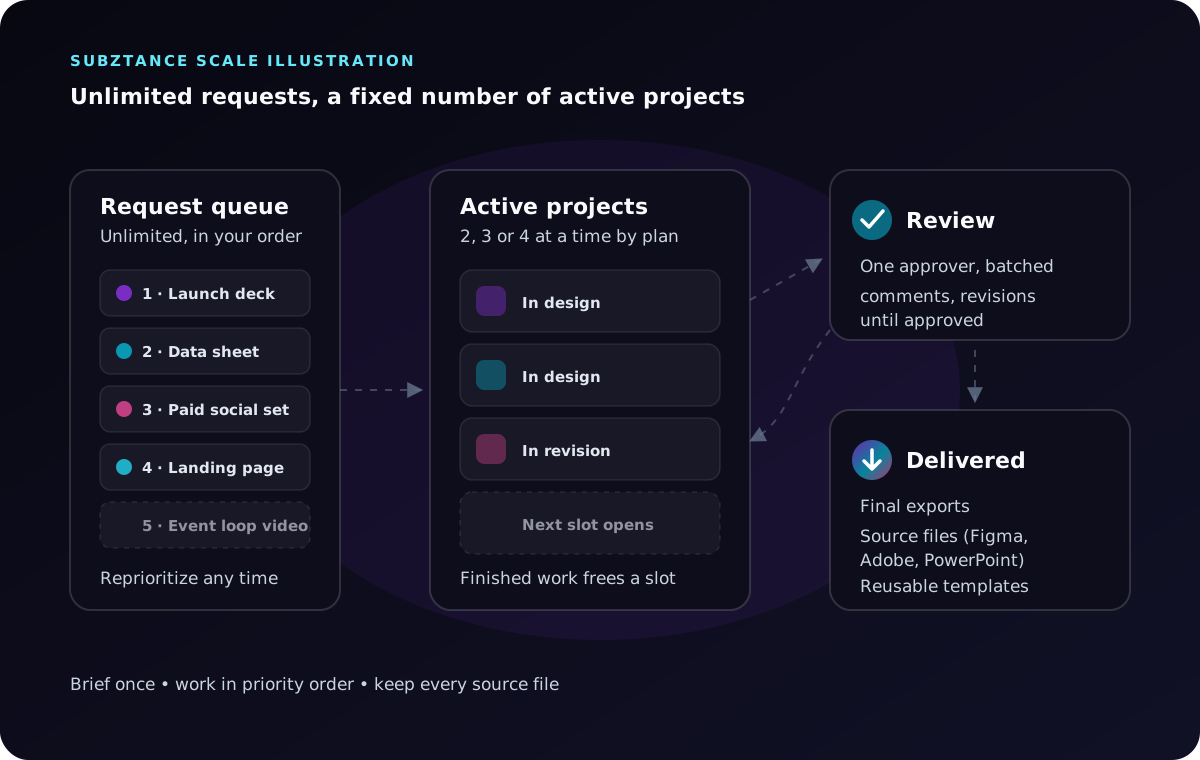
Subztance Scale illustration of the subscription request workflow described on our How It Works page. Original company artwork.
The terms below appear in most subscription offers. Each one deserves a precise answer before you sign up.
| Term | What it usually means | What to confirm |
|---|---|---|
| Unlimited requests | No cap on the number of requests in your queue | Whether large projects are split into several requests |
| Active projects | How many requests are in progress at once | The number per plan, and whether it covers design, web, and video |
| Turnaround | Average time to a first draft for typical requests | Business days or calendar days, and the range for complex work |
| Revisions | Rounds of changes on a request | Whether revisions are unlimited or capped per request |
| Source files | The editable working files behind each deliverable | File formats included and who owns them after approval |
| Pause or cancel | How you stop billing when work slows | Notice period, contract length, and how paused time is counted |
At Subztance Scale, requests go through a client portal where you upload briefs, copy, wireframes, and reference visuals, then give feedback directly on the work. Most requests get a first draft in 1–2 business days, and web and motion projects take 3–5 business days. The How It Works page walks through each step.
Why B2B Teams Are Rethinking How They Resource Design
Content volume is outgrowing marketing teams. In the Content Marketing Institute's research for 2026, based on 1,015 B2B marketers surveyed in mid-2025, 39% named resource constraints (time, people, and budget) as a challenge, and 28% said one of their biggest obstacles was creating enough quality content to meet organizational needs. (Content Marketing Institute, "B2B Content and Marketing Trends: Insights for 2026")
The number of places that content must appear is also growing. McKinsey's 2026 Global B2B Pulse research found that buyers use an average of 10 channels during the purchasing journey, and it identifies inconsistent information as a leading reason buyers switch suppliers. (McKinsey, "The surprising economics of B2B growth")
More channels means more formats, more variants, and more opportunities for claims and visuals to drift apart. Traditional resourcing options each solve part of that problem:
- A full-time designer brings deep brand knowledge but usually one core discipline.
- Freelancers add flexibility, but every new freelancer needs onboarding, and availability is not guaranteed. In the United States, about 20% of graphic designers were self-employed in 2025. (U.S. Bureau of Labor Statistics, Occupational Outlook Handbook)
- A project agency brings range and process, but each project needs a scope, a quote, and a statement of work.
A subscription sits between these options. It combines the continuity of an internal team with the range of an agency, at a predictable monthly cost.
10 Benefits of a Graphic Design Subscription
1. A Predictable Monthly Cost
A flat fee replaces project quotes, hourly invoices, and change orders. Finance can forecast creative spend a quarter ahead, and marketing no longer needs to justify each new request with a separate budget approval. When a launch doubles the workload for a month, the invoice does not double with it.
2. Capacity in Days, Not a Hiring Cycle
Recruiting takes time before a new hire contributes anything. SHRM's 2026 recruiting benchmarking puts the median time to fill a nonexecutive position at 39 calendar days, before onboarding begins. (SHRM, 2026 Recruiting Executives Benchmarking) A subscription starts when you sign up: your first briefs go into the queue the same day, with no recruiting, interviewing, or onboarding of a new employee. That matters when a product launch or trade show date is already fixed.
3. Senior Range Across Disciplines
Most B2B campaigns need more than static graphics. A single launch might require a presentation, a technical data sheet, landing page updates, a product walkthrough video, and paid social animation. On a subscription, those requests go through one queue to specialists in design, web, motion, and video. Browse the full range of creative services to see what a single team can cover.
4. Brand Consistency From One Team
Every new freelancer or agency starts from zero with your brand. A subscription team works on your account continuously, so your typography, colour palette, diagram style, and product terminology become familiar. That continuity is how a consistent brand visual identity survives dozens of formats and channels.
5. Less Vendor Management
Coordinating several freelancers means several briefing formats, file-sharing habits, invoices, and approval routes. A subscription gives you one portal, one brief format, one invoice, and one dedicated creative director. The time your team saves on coordination goes back into strategy and approvals.
6. Faster Turnaround on Repeatable Work
Much of B2B design is repeatable: resizing a campaign across ad formats, updating a data sheet for a new model, adapting a slide for a regional team, or producing event signage from an approved concept. Because the team already holds your templates and source files, these requests can be delivered in days instead of waiting behind a new project scope.
7. Flexibility to Scale or Pause
Marketing demand follows launches, events, and fiscal quarters. A subscription lets you move to a plan with more active projects during a busy season and pause when work slows. At Subztance Scale there are no long-term contracts, you can pause or cancel from the client portal, and every subscription comes with a 14-day money-back guarantee. Compare the published plans and prices to see how capacity changes by tier.
8. Source Files and Ownership Stay With You
Your creative assets should remain usable after any engagement ends. A good subscription includes editable source files (Figma, Adobe Creative Cloud, PowerPoint, and similar) with every deliverable, and full ownership of the work once it is approved. That protects you if you change providers, bring work in-house, or brief a partner.
9. Your Internal Team Moves Up the Value Chain
When production moves to a subscription, the internal team can focus on work that requires company knowledge: positioning, audience decisions, product accuracy, and campaign approvals. That division of labour is the core of the insourcing versus outsourcing decision: keep the judgement in-house and outsource the production capacity.
10. A Reusable Creative System Instead of One-Off Files
Over months, a subscription produces more than individual assets. It builds a library of templates, modular layouts, diagram styles, and motion behaviours that make each new request faster. Our B2B campaign design guide explains how to turn one campaign into a modular system of this kind.
What a Graphic Design Subscription Costs Compared With the Alternatives
A useful cost comparison looks at the total cost of getting finished work, not only a salary or a monthly fee.
Hiring in-house. In Canada, the median wage for graphic designers and illustrators (NOC 52120) is $31.25 an hour, according to Job Bank's 2023–2024 wage data. (Job Bank, Government of Canada) At 37.5 to 40 hours a week, that works out to roughly $61,000 to $65,000 a year before any employer costs. In the United States, the median annual wage for graphic designers was $62,960 in May 2025. (U.S. Bureau of Labor Statistics)
Salary is not the whole cost. In U.S. private industry, benefits accounted for 30.0% of employer compensation costs in June 2026, with wages and salaries making up the remaining 70.0%. (U.S. Bureau of Labor Statistics, Employer Costs for Employee Compensation) Software licences, equipment, recruiting time, management, and cover for holidays and sick days add further cost.
Freelancers charge by the hour or by the project. They can be cost-effective for occasional, well-defined work, but costs become hard to forecast as volume grows, and each new freelancer adds onboarding and coordination time.
Project agencies quote each project separately. That suits large, clearly scoped programs, but it adds scoping time and change orders to smaller, fast-moving requests.
Subscriptions charge a flat monthly fee for defined capacity. Subztance Scale plans start at $4,999 CAD a month for graphic, presentation, and social design with two active projects, and higher tiers add web design and development, branding, motion graphics, video editing, and marketing services.
| Model | Cost structure | Time to start | Range of disciplines | Best fit |
|---|---|---|---|---|
| In-house designer | Salary plus benefits, tools, and management | Weeks to months | Usually one core discipline | Daily, highly embedded work |
| Freelancers | Hourly or per project | Days, subject to availability | Varies by individual | Occasional, well-defined tasks |
| Project agency | Scoped quote per project | Weeks, after scoping | Broad | Large programs with a fixed scope |
| Design subscription | Flat monthly fee | Days | Broad, through one queue | Continuous, mixed B2B workloads |
A subscription is not the cheapest way to buy a single designer's hours. Its value comes from what a single hire cannot provide: several disciplines, senior specialists, capacity that starts in days, and the freedom to scale up or pause without hiring or layoffs.
When a Subscription Is Not the Right Fit
A subscription is a strong model for continuous work, but it is not the answer to every creative need. Consider another option when:
- Your volume is very low. If you need a few assets a quarter, a trusted freelancer is likely to cost less.
- You need one large, fixed-scope project. A full rebrand that includes research, naming, and positioning workshops may be better scoped as a project. A subscription can then carry the new identity into everyday production.
- The work needs someone embedded full-time. If a designer must sit in daily product meetings or work on-site, a hire may be the right choice.
- Nobody owns briefs and approvals. Every outsourcing model depends on a clear brief and a decisive reviewer. Without an internal owner, requests stall regardless of who produces them.
How to Evaluate a Graphic Design Subscription Provider
Providers can look similar on a pricing page and differ sharply in practice. Ask these questions before choosing one:
- Capacity: How many active projects does each plan include, and what counts as one request?
- Turnaround: Is turnaround measured in business days? What range applies to complex web, motion, and video work?
- Disciplines: Which services does each plan include, and which cost extra?
- Seniority: Who works on your account? Is there a dedicated creative director?
- Revisions: Are revisions unlimited, and how is feedback given?
- Ownership: Are source files included, and do you own the work outright once it is approved?
- Commitment: Is there a minimum contract? How do pausing and cancelling work, and is there a refund if the work does not meet your standards?
- Tools: Can the team work in the formats your organization uses, such as Figma, Adobe Creative Cloud, PowerPoint, Google Slides, Webflow, or HubSpot?
- Technical accuracy: Can the team handle specifications, architecture diagrams, and data visualization without introducing errors?
- Confidentiality: How are unreleased products and pre-launch materials protected?
- Hours and communication: When is the team available, and in which time zone? Subztance Scale works Monday to Friday, 8:30 a.m. to 5 p.m. Eastern.
- Relevant work: Can the provider show examples from your industry? Review our portfolio of B2B design, web, and motion work.
Get the Most From the First 30 Days
The first month sets the working rhythm. A little preparation turns a subscription from a queue of tasks into a reliable production system.
Before the first request, upload your brand guidelines, logo files, fonts, templates, product imagery, and a short list of approved product names and claims. Name one internal person as the approver for each type of work.
Write complete briefs. Each request should include the goal, the audience, the format and dimensions, final or draft copy, the deadline, reference examples, and any claims that need approval. For deeper technical assets, our B2B sales collateral guide explains how to build a message-and-evidence source that keeps specifications accurate.
Keep the queue full and ordered. Because work moves from the queue into active slots, a well-stocked queue keeps the team productive. Put urgent work at the top and add routine requests behind it.
Batch your feedback. Consolidate comments from stakeholders before sending them. One clear round of feedback is faster than several conflicting ones.
Review after 30 days. Look at turnaround by request type, the number of revision rounds, and which requests needed more context. Then adjust your brief template and your plan level.
Estimate the Capacity You Actually Need
Before comparing plans, list what your team produces in a typical month and in a peak month:
- Campaign graphics and paid media variants.
- Presentations and sales decks.
- Data sheets, brochures, and other sales collateral.
- Landing pages and website updates.
- Social graphics and short-form video.
- Event, trade show, and partner assets.
Then estimate how many of those need to be in progress at the same time. That number, more than the total volume, decides which plan fits. The Creative Capacity Assessment takes about three minutes and recommends a plan based on your services, workload, and campaign calendar.
Graphic Design Subscription FAQ
What's Included in a Graphic Design Subscription Each Month?
You get a team's ongoing capacity rather than a fixed list of files: an unlimited request queue, a set number of projects in progress at once, the disciplines your plan covers, unlimited revisions, and the source files for everything you approve. At Subztance Scale, plans work on 2, 3 or 4 requests at the same time, and the pricing page shows which services each plan includes.
Do Design Subscriptions Include Revisions and Source Files?
Most do, but check the details before you sign up. At Subztance Scale, revisions have no limit, and the editable source files and ownership of the work are yours once you approve a deliverable.
How Do Unlimited Revisions Work?
You comment directly on the file, in the client portal or in Figma, Adobe or Webflow, and the team revises until you approve it. Revisions happen inside the request's active slot, so the next request in your queue starts once the current one is approved.
What Should You Look For in a Design Subscription?
Start with active project capacity, turnaround in business days, which disciplines are included, who works on your account, and how pausing, cancelling and refunds work. The evaluation checklist above covers each question in detail.
Is a Flat-Fee Design Subscription Worth It for a Marketing Team?
It is when design demand is continuous and varied: launches, campaigns, sales collateral and web updates every month. You get a predictable cost, senior range across disciplines, and no hiring cycle. If you need only a few assets a quarter, a freelancer is likely to cost less.
Choose the Model That Matches the Work
A graphic design subscription works best when design demand is continuous, varied, and tied to launches and campaigns that cannot wait for a hiring cycle. It gives B2B marketing teams predictable cost, senior range, consistent brand execution, and ownership of every source file, while the internal team keeps control of strategy and approvals.
Compare the subscription plans, see how the workflow runs, or send us your upcoming launches, campaigns, and deadlines. We will recommend the capacity that fits your team.
Launch With Every Asset in Sync.
Senior designers who know technical B2B update your datasheets, decks, landing pages and ads, with first drafts in 1–2 business days.
- 14-Day Money-Back Guarantee
- No Contracts, Pause Anytime
- Dedicated Creative Director


